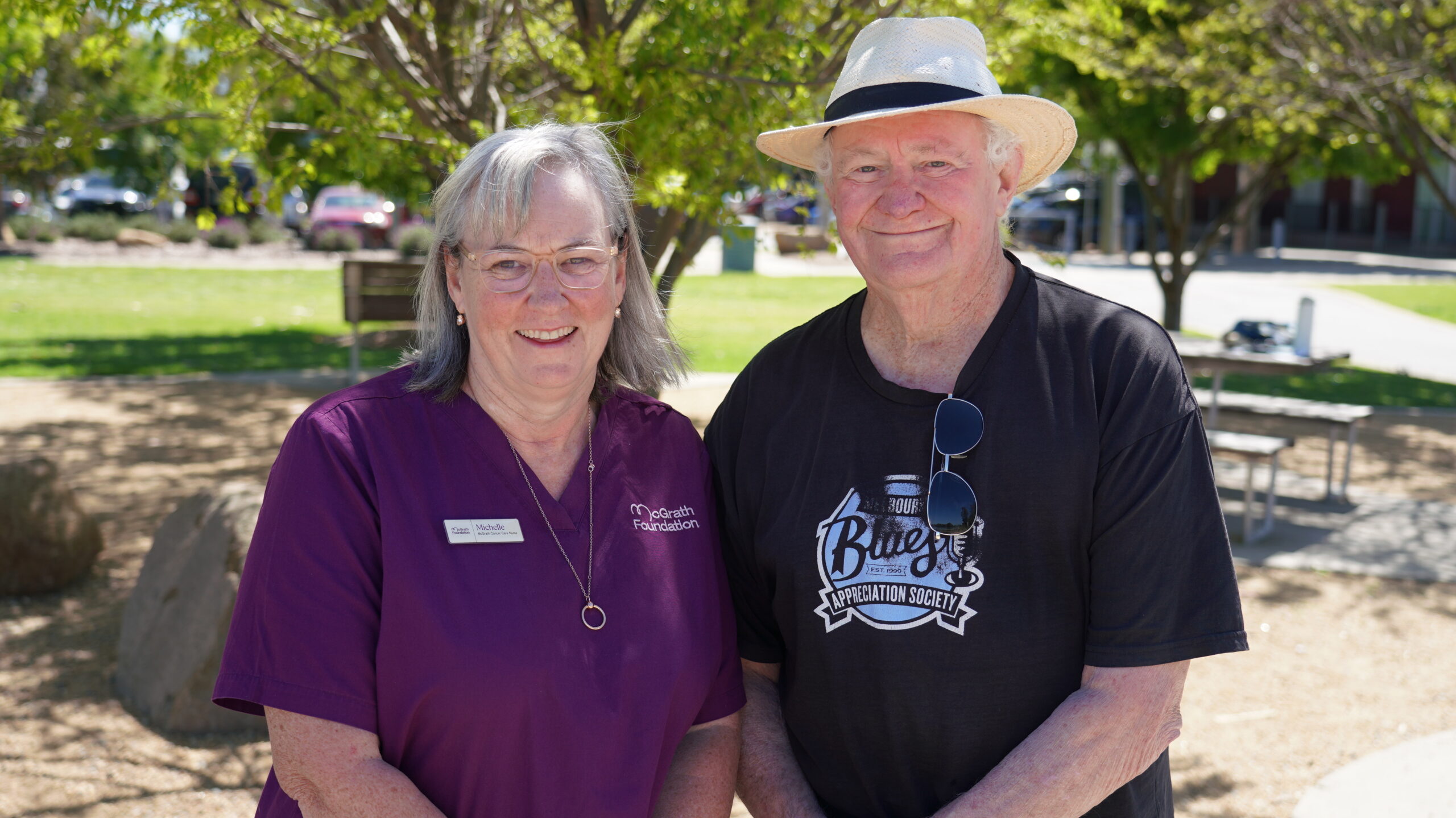
‘Blokes get breast cancer too’
Cancer develops in breast tissue, which we all have, no matter what sex we are
This Breast Cancer Awareness Month, John Bush, a breast cancer survivor, has a simple message for men: breast cancer is not just a women’s disease.
Last November, John was taking off a T-shirt when the hem caught on his chest.
“I thought, ‘Oh, that’s a lump,’” he said.
He saw his GP straight away.
“She said, ‘I don’t like that at all. You are going to have a biopsy as soon as possible,’” John said.
A mammogram and biopsy found a lump that needed to come out. John had surgery a week before Christmas, then three rounds of chemotherapy and 15 days of radiation therapy.
His cancer is hormone-positive, so he will take a tablet called tamoxifen for at least five years, or maybe 10.
“I said, guarantee me 10 more years and I’d be happy,” he laughed.
“The service I’ve had at GV Health has been fantastic,“ John said.
About 207 of the 20,336 Australians estimated to be diagnosed with breast cancer in 2025 were men, according to Cancer Australia. One in 668 Australian men will be diagnosed in their lifetime.
McGrath/GV Health Breast Care Nurse Michelle Parish said men are often diagnosed later because they don’t expect it. Nearly half are diagnosed at stage three, when the cancer has already grown.
“When it comes to men, we focus on prostate, we focus on bowel, we focus on skin, we focus on heart disease, and rarely breast cancer,” Michelle said.
In 17 years, Michelle has cared for at least 12 to 15 men with breast cancer. The average age at diagnosis is 69, but her youngest male patient was 29.
Family history can play a part. John’s younger sister has also had breast cancer.
Michelle said signs to look out for in men include a lump, often behind the nipple, changes to the nipple, and fluid coming from the nipple.
She said every breast cancer is different, and treatment is planned around each person.
“I compare breast cancer to fruit. There are so many different types,” she said.
“Even two Granny Smith apples from the same tree aren’t the same.”
Michelle said more men are now living five years and beyond after breast cancer, thanks to better treatment and finding it earlier.
“Early detection is the key,” she said.
GV Health‘s breast care nurses support local women and men diagnosed with breast cancer, from diagnosis through treatment and beyond, while hosting regular community information sessions.
Routine, population-wide breast screening is not recommended or available for men in Australia because male breast cancer is rare, accounting for about 1% of all cases. So, anyone who notices a lump, nipple change or discharge should see their GP.
Male breast cancer remains under-recognised as cultural feminisation of the disease contributes to embarrassment and delayed care-seeking, leading to more advanced stage at diagnosis.
“Men who have noticed a change but keep putting off a check-up, don’t be a d***head, go and get tested,” John said.
Before his diagnosis, John had grown his silver hair to his shoulders along with his 17-year-old grandson, so they could both donate it to make wigs for people with cancer. He had just donated his hair when he found out he had cancer.
To contact GV Health‘s breast care support nurses, email breastcareservices@gvhealth.org.au.
BREAST CANCER INFORMATION SESSION
Learn about signs and symptoms, treatment, and services to support local women and men diagnosed with breast cancer.
Guest speaker: Michelle Parish, McGrath/GV Health Breast Care Nurse
Wednesday 21 October, 6 pm
Murchison Men’s Shed, 10A Watson Street, Murchison
All community members are welcome. Finger food available.
RSVP: 0428 148 210